The Dawn of a New Era: Quantum Computing’s Impact on Financial AI
The world of finance is undergoing a seismic shift, driven by the relentless march of artificial intelligence (AI). However, the limitations of classical computing are increasingly apparent, particularly when dealing with the complexity inherent in financial modeling, fraud detection, and risk assessment. Enter quantum computing, a revolutionary technology poised to redefine the landscape of financial AI, offering unprecedented speed and power to tackle problems currently beyond the reach of even the most advanced classical systems.
Beyond Classical Limits: The Quantum Leap
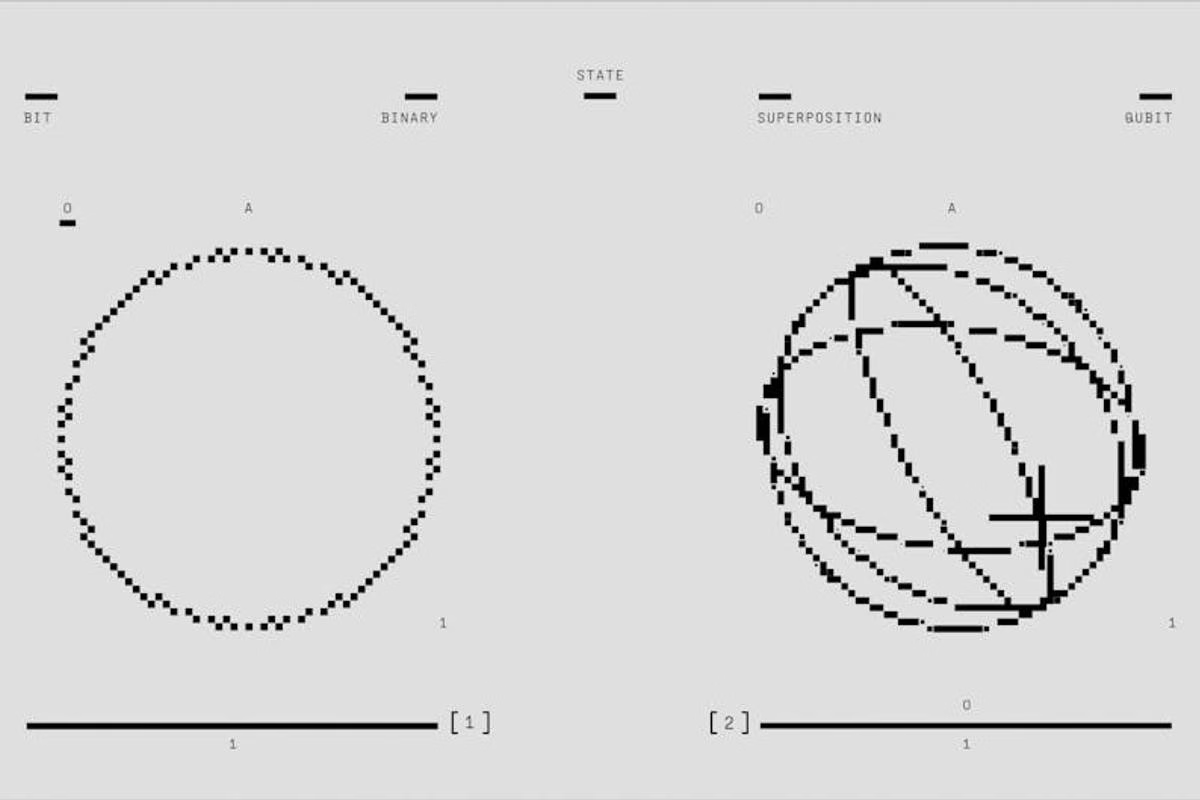
Classical computers, based on bits representing 0 or 1, struggle with the exponentially increasing complexity of many financial problems. For instance, accurately modeling market behavior, factoring in countless variables like global economic indicators, investor sentiment, and news events, is a computationally intensive task. Classical algorithms often fall short, leading to imprecise predictions and suboptimal strategies.
Quantum computers, however, leverage the principles of quantum mechanics, employing qubits that can exist in multiple states simultaneously – a phenomenon known as superposition. This allows them to perform calculations at speeds unimaginable for classical computers. Furthermore, quantum entanglement, where two or more qubits are linked regardless of the distance separating them, allows for even more efficient and parallel processing.
Transforming Financial AI: Key Applications
The integration of quantum computing with financial AI is unlocking a range of transformative applications:
1. Enhanced Risk Management:
Quantum algorithms offer the potential for significantly improved risk assessment and management. Monte Carlo simulations, currently used extensively in finance to predict potential outcomes, can be dramatically accelerated using quantum computers. This enables financial institutions to better evaluate and mitigate risks associated with investments, trading strategies, and other financial operations. The ability to analyze far more complex scenarios and variables translates to more accurate predictions and safer decision-making.
2. Algorithmic Trading Revolutionized:
High-frequency trading (HFT) relies on lightning-fast algorithms to execute trades based on minute market fluctuations. Quantum computing could revolutionize HFT by significantly reducing latency and enabling the processing of vastly more data in real-time. This could lead to more profitable trading strategies, improved market efficiency, and potentially decreased volatility.
3. Fraud Detection Enhanced:
Quantum algorithms can identify patterns and anomalies in large datasets far more effectively than classical methods. This capability is particularly valuable in fraud detection, enabling financial institutions to swiftly identify and prevent fraudulent transactions. The ability to analyze complex networks of transactions, uncover hidden connections, and predict fraudulent behavior with increased accuracy is a game-changer in combating financial crime.
4. Portfolio Optimization:
Building optimal investment portfolios involves navigating a complex space of asset allocations, considering risk tolerance, expected returns, and various market conditions. Quantum optimization algorithms can significantly enhance the efficiency of portfolio construction, enabling the identification of portfolios that maximize returns while minimizing risk. This can lead to superior investment strategies and increased returns for investors.
5. Enhanced Cybersecurity:
The security of financial data is paramount. Quantum cryptography promises to revolutionize cybersecurity by leveraging quantum mechanics to create unbreakable encryption techniques. Quantum-resistant algorithms are being developed to protect against future attacks from quantum computers, ensuring the confidentiality and integrity of financial information.
Challenges and the Road Ahead
Despite its immense potential, the integration of quantum computing in financial AI is still in its nascent stages. Several challenges remain:
- Hardware limitations: Building stable and scalable quantum computers is a significant engineering challenge. Current quantum computers are still relatively small and prone to errors.
- Algorithm development: Developing efficient quantum algorithms tailored to specific financial problems requires significant research and expertise.
- Data preparation: Preparing financial data for quantum computations is a complex task, requiring careful data transformation and pre-processing.
- Cost and accessibility: Quantum computers are currently expensive and not readily available to everyone, limiting widespread adoption.
However, significant progress is being made, and the development of quantum computing technology is accelerating at a rapid pace. As quantum computers become more powerful, stable, and accessible, their impact on financial AI will become increasingly profound, reshaping the industry and opening up entirely new opportunities.
Conclusion: A Transformative Future
The convergence of quantum computing and financial AI promises a transformative future for the finance industry. While challenges remain, the potential benefits are too significant to ignore. We are standing at the cusp of a new era, where quantum algorithms will unlock previously inaccessible insights, improving risk management, revolutionizing trading strategies, enhancing fraud detection, and strengthening cybersecurity. The journey ahead is exciting, and the future of finance is inextricably linked to the progress of quantum computing.
Frequently Asked Questions
What are the main applications of quantum computing in financial AI?
Quantum computing enhances financial AI in several key areas: risk management, algorithmic trading, fraud detection, portfolio optimization, and cybersecurity. It promises faster, more accurate, and more sophisticated solutions than classical computing.
How does quantum computing improve risk management in finance?
Quantum computing accelerates Monte Carlo simulations, allowing for more comprehensive risk assessments. It can handle far more variables and scenarios, leading to more accurate predictions and better mitigation strategies.
What are some of the challenges hindering the widespread adoption of quantum computing in finance?
Current limitations include the availability and stability of quantum hardware, the need for specialized quantum algorithms, the complexity of data preparation, and the high cost of access to quantum computing resources.
Is quantum computing a threat to the security of financial data?
While quantum computers could potentially break current encryption methods, they also offer the solution through quantum cryptography, which promises even more secure encryption techniques.